How to Build an AI-Native B2B SaaS Platform: Architecture, Costs, and Core Features
Learn to design an AI-native B2B SaaS platform from the ground up.
Posted
July 27, 2026
Author
Divyanshu Gupta
Founder's Office
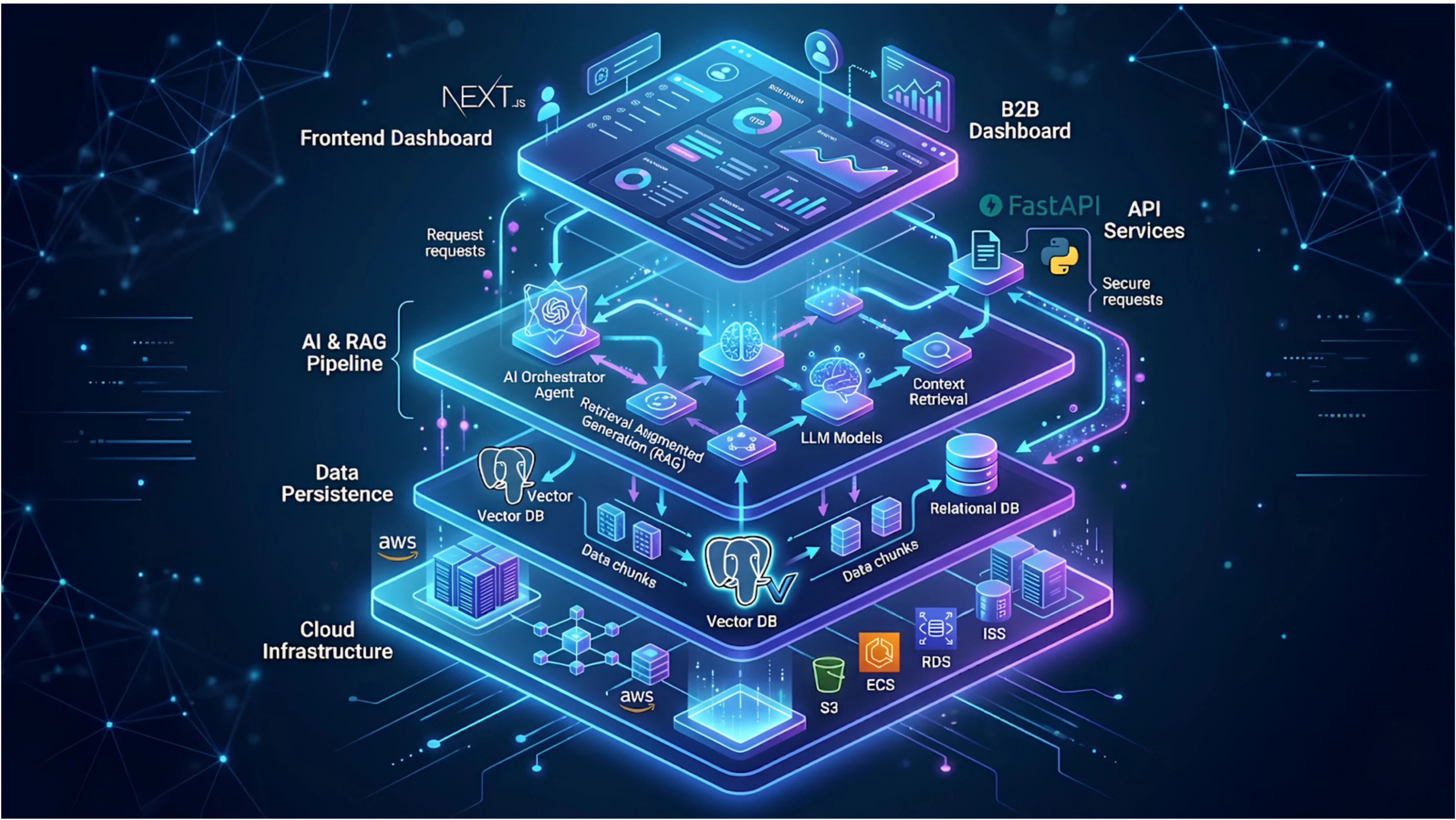
Most AI SaaS products today fail not because of lack of ideas, but because they are built as thin wrappers over existing APIs with no real defensibility. As AI rapidly becomes a standard feature, founders and product leaders need to rethink how they build software, from simple tools to intelligent systems that can reason, act, and deliver outcomes. In this blog, you’ll learn how to design an AI-native B2B SaaS platform from the ground up, including the right architecture, realistic development costs (especially in the Indian context), core features, and the common mistakes to avoid while building for scale.
The Paradigm Shift: Defining the AI-Native B2B Platform
The global Software-as-a-Service (SaaS) market has gone through a major shift, reaching an estimated value of $465.03 billion in 2026 (Quantumrun Foresight). Earlier, SaaS was about moving from on-premise software to cloud subscriptions. Today, the shift is much bigger, from static tools to autonomous platforms. For founders, this means the goal is no longer just to store and manage data, but to build systems that can think, decide, and take action.
According to a 2025 McKinsey report, 78% of organizations have already integrated AI into their core operations. However, there’s a clear gap. While 89% of revenue teams use AI in some form, most are still stuck at the surface level, building simple “wrappers” instead of truly defensible, AI-native products.
This “AI wrapper” problem, where startups build thin interfaces on top of third-party APIs, has already led to many failures. As companies like OpenAI and Anthropic continue to add features like file handling, web search, and memory directly into their models, products that rely only on these features are quickly becoming irrelevant. To build a successful AI B2B SaaS platform in 2026, you need AI-native architecture, proprietary data, and agent-driven workflows.
The distinction between "AI-native" and "AI-washed" is the single most important factor in determining the long-term viability of a product. Gartner projects that by the end of 2026, more than 80% of companies will have deployed AI-enabled applications, up from just 5% in 2023. In this crowded market, what sets you apart is your "Decision Layer", the way your system connects data, reasoning, and actions to solve problems.
How Your AI Product Creates Value and Stays Competitive
Traditional SaaS products were built as "Systems of Record", their main job was to store and organize data in one place. AI-native platforms are different. They act as "Systems of Action," where the software doesn’t just store data but actually takes actions and completes tasks automatically.
This shift is often called "Service-as-a-Software", instead of selling access to a tool (like seats in an accounting software), companies can now sell outcomes (like fully prepared financial reports). Here’s how traditional SaaS compares with AI-native platforms:
| Feature Category | Traditional SaaS (AI-Washed) | AI-Native Platform |
|---|---|---|
| Core Interface | Dashboards and complex menus | Natural language and agentic triggers |
| Data Interaction | Manual entry and static reporting | Autonomous ingestion and insight generation |
| Defensibility | High switching costs of data | Proprietary logic and compounded learning |
| Business Model | Per-seat subscription | Usage-based or outcome-based pricing |
| Role of AI | Optional "Copilot" feature | Core operating and orchestration layer |
In 2026, the real advantage doesn’t come from just adding AI, it comes from combining AI with what makes your business unique, such as your domain expertise, customer relationships, and operational workflows.
Research from PwC shows that while 56% of CEOs see no ROI from AI investments, the 12% who are seeing real returns are those building custom AI solutions tailored to complex business processes, instead of relying on generic, off-the-shelf tools.
Core Architecture: How to Build a Scalable AI SaaS Product
Building an AI SaaS product is not like building a typical web app. Your system needs to handle multiple AI requests at once, manage delays from model responses, and work with large amounts of unstructured data. In most modern AI SaaS products, teams are converging on a simple and effective stack:
- Next.js for frontend
- Python (FastAPI) for backend
- PostgreSQL (with vector support) for data
Frontend: Building a Fast and Responsive AI Experience
In AI products, speed and user experience matter a lot. If your app feels slow, users will drop off quickly. Next.js has maintained its dominance as the preferred framework for AI-driven interfaces due to its native support for streaming and server-side logic.
- Streaming responses:
Instead of making users wait, show AI responses as they are being generated.
- Edge processing:
Run lightweight checks (like moderation or language detection) closer to users to reduce delay.
- Secure API handling:
Keep API keys on the server to avoid security risks.
Backend Orchestration: FastAPI and Python
While the frontend handles the "view," the "brain" of the platform resides in the backend. The backend is where your product actually "thinks" and makes decisions. Python remains the non-negotiable standard for the AI backend because of its deep integration with frameworks like Pydantic, LangChain, and the foundational ML libraries.
Python is preferred because it works well with AI tools. FastAPI helps handle multiple AI requests efficiently due to its native support for asynchronous programming. This makes sure that the platform can manage hundreds of concurrent LLM calls that each take 5–15 seconds to complete. Validation tools ensure AI outputs don’t break your system.
Data Layer: Keep It Simple with PostgreSQL
A common mistake founders make is overcomplicating the data layer too early by using multiple databases. In most cases, you can start with a single PostgreSQL setup and scale only when needed.
For many B2B AI applications, it’s more efficient to keep everything in one place: user data (billing, permissions, records) along with AI-related data (embeddings, knowledge base, memory). With the pgvector extension, PostgreSQL can handle similarity search along with normal SQL queries. This means you can do things like: "Find results similar to this query, but only for enterprise customers" all within the same system.
From a performance standpoint, this setup is more capable than most founders expect. Recent 2026 benchmarks show that pgvectorscale can handle 471 queries per second at 99% accuracy on 50 million vectors, making it competitive with specialized vector databases for most mid-sized B2B use cases.
Multi-Tenancy: The Backbone of B2B SaaS
If you’re building a B2B SaaS product, multiple customers (tenants) will use the same platform, but their data must stay completely separate.
In AI products, this becomes even more critical. It’s not just about separating database rows, it’s about making sure one customer’s private data is never used in another customer’s AI response. Even a small mistake here can break trust and create serious compliance risks.
Choosing the Right Multi-Tenancy Model
There are three common ways to design multi-tenancy, each with trade-offs in cost, scalability, and security:
| Model | Description | Pros | Cons |
|---|---|---|---|
| Fully Isolated (Siloed) | Each customer has their own database and vector storage | Highest security; zero risk of data leakage or performance interference | Very expensive and hard to manage at scale |
| Fully Shared (Logical) | All customers share one database, separated using a tenant ID | Most cost-effective and easy to scale | Risk of data leakage if isolation is not implemented correctly; performance issues possible |
| Hybrid (Namespace) | Shared infrastructure with logical separation using schemas or namespaces | Best balance of cost, performance, and security (industry standard in 2026) | Requires more complex setup and management |
The "Noisy Neighbor" Problem in AI
In AI systems, one customer can generate a large number of AI requests (like running multiple workflows), which can slow down the system or increase costs for everyone else. To avoid this, you need to build safeguards from the start:
- Set usage limits per customer.
- Implement rate limiting for API calls.
- Track and control AI usage costs (FinOps approach).
Vector Infrastructure: Choosing the Right Database
As your AI product grows, it needs to search and retrieve information in real time, often across millions of data points. This is where vector databases come in. What used to be an experimental choice is now a core production decision for AI SaaS products. Here are some of the most widely used options in 2026:
| Database | Best For | 2026 Performance (p95) | Key Differentiator |
|---|---|---|---|
| Pinecone | Fully managed setup | 50–100ms | Serverless by default; scales to billions of vectors |
| Qdrant | More control & customization | 50–70ms | Built in Rust; strong filtering and edge deployment support |
| Milvus | Enterprise-scale systems | 40–60ms | GPU-accelerated; very fast indexing on high-end hardware |
| pgvector | Simple + unified setup | 50–100ms | Runs inside PostgreSQL; no need for a separate system |
| Weaviate | Built-in AI features | 50–100ms | Native integrations with models like OpenAI and Anthropic |
If you’re just getting started, don’t over-engineer this early. Start with pgvector (inside PostgreSQL) or Chroma for quick development, and move to tools like Qdrant or Pinecone only when you scale beyond 10–50 million vectors or need advanced performance. The goal is simple: start fast, then scale when needed, not the other way around.
Integrating AI: RAG and Agentic Workflows
B2B users don’t want a list of documents anymore, they want clear answers based on their own data. This is what Retrieval-Augmented Generation (RAG) enables: combining your company’s data with AI to generate accurate, contextual responses.
From Basic RAG to Agentic RAG
Research indicates that over 65% of businesses using basic "Naive RAG" systems receive incomplete or off-target results. Most early RAG systems are quite simple:
user query → search relevant data → send to AI model → generate answer
But this approach has limitations. Research shows that over 65% of businesses using basic RAG get incomplete or inaccurate results. The system doesn’t know whether the retrieved data is actually useful, it just passes it along.
Agentic RAG solves this by making the AI more intelligent and iterative. Instead of a one-shot response, the system can refine the search query, try different data sources, and ask follow-up questions if needed. In simple terms, the AI doesn’t just answer, it thinks through the problem before responding.
Seven Essential Chunking Strategies
A major failure point in production RAG is poor "chunking", the process of breaking documents into smaller pieces before embedding them. Chunks that are too small lack context; chunks that are too large dilute the signal.
- Fixed-Size Chunking: Simple and fast, but often splits sentences or tables in the middle, destroying semantic meaning. Scored only 67% in the 2026 FloTorch benchmark.
- Recursive Character Splitting: The baseline for most general-purpose apps. It tries to split paragraphs, then sentences, ensuring the most natural boundary possible.
- Semantic Chunking: Uses a model to detect topic transitions. This is up to 9% more accurate than fixed-size methods but adds to ingestion costs.
- Page-Level Chunking: Ideal for PDFs with complex layouts. This approach won NVIDIA’s 2025 benchmarks for handling tables and financial reports.
- Sentence-Based Chunking: Best for conversational data or FAQs where each thought must remain whole.
- LLM-Based Chunking: High-value but slow. An LLM reads the document and decides where to split it. Prohibitive for large corpora.
- Late Chunking: Addresses the issue of long documents exceeding context windows while maintaining the relationship between distant parts of the text.
What Founders Should Take Away
- Basic RAG is easy to build, but hard to get right in production.
- Moving to agentic workflows significantly improves accuracy and reliability.
- Chunking strategy alone can make or break your AI performance.
The Economics of AI: What It Really Costs in 2026
Building an AI SaaS product is more expensive than traditional software. The main reasons are ongoing AI usage costs (inference costs) and the need for experienced engineers who understand AI systems. If you underestimate this, you risk ending up with a "zombie MVP", a product that’s too weak for real users but too expensive to rebuild.
Stage-by-Stage Build Costs
According to 2026 industry data, building a production-grade AI platform is a six-figure investment. Teams that underestimate this often find themselves with a "zombie MVP" that is too buggy for production but too expensive to rewrite.
| Product Stage | Starting Cost (INR)* | Timeline | Focus |
|---|---|---|---|
| Simple MVP | ₹2L+ | 5–8 weeks | Validate one core AI idea (e.g., prompt workflows) |
| Standard SaaS MVP | ₹8L+ | 8–14 weeks | Multi-tenant product with basic integrations |
| AI-Powered MVP | ₹25L+ | 3–6 months | LLM integration, custom RAG, and production readiness |
| Enterprise Platform | ₹80L+ | 6–18 months | Large-scale system with compliance and complex integrations |
*These are indicative starting costs based on practical experience. Final budgets vary based on scope and complexity. Contact Avisoft for a tailored estimate.
What Drives Cost Up or Down?
A few key factors can significantly impact your budget:
- Engineering Talent:
In the Indian market, development costs are relatively lower, but AI systems still require experienced engineers and at least one strong architect to design scalable workflows. Hiring only junior developers to save costs often leads to poor architecture decisions, which become expensive to fix later.
- AI Usage (Inference Costs):
One of the biggest ongoing expenses in AI products is model usage. Even in India, using models from providers like OpenAI or Anthropic can cost $0.01 to $0.10 per request, which quickly adds up. At scale (e.g., 10,000 requests per day), this can translate into ₹2.5L to ₹25L+ per month.
- Founder Decision Speed:
AI product development is highly iterative, and delays in decision-making can directly increase costs. Even a one-week delay in finalizing features or scope can waste significant development effort and increase burn without meaningful progress.
- AI-Assisted Development (Cost Advantage):
Tools like Claude Code and Cursor are helping Indian teams build faster and more efficiently. Many startups are seeing 30–50% faster development cycles, reducing overall costs when used effectively.
AI products come with ongoing costs beyond just development, especially due to model usage. Poor planning or unclear scope can quickly lead to budget overruns, while slow decision-making increases burn without adding value. At the same time, choosing the right team and leveraging modern AI development tools can significantly reduce both costs and timelines, making execution discipline just as important as the idea itself.
Must-Have Features for B2B AI SaaS
To move from a simple tool to a scalable platform, you need more than just core functionality. Enterprise buyers look for systems that are reliable, secure, and measurable, especially when AI is involved.
Observability and AI Governance
In AI products, it’s not enough to know that your system is running, you need to understand why it behaves the way it does. When an AI gives a wrong answer, you should be able to trace what happened. Tools like LangSmith or Arize Phoenix help track how each response was generated, including token usage, costs, and steps taken by the system.
Equally important is continuous evaluation. Without proper testing, most RAG systems degrade over time, studies show 73% see performance drops within 90 days. You need a system that regularly checks accuracy against known data. For sectors like healthcare and finance, data privacy is critical. Your platform must automatically detect and mask sensitive information before sending it to external AI models.
Monetization and Billing
Traditional SaaS pricing doesn’t work well for AI products because costs are driven by usage, not just users. Most successful AI companies now use a hybrid model, a base subscription plus usage-based pricing for AI actions.
Some advanced companies go even further with outcome-based pricing, where customers pay for results (like leads generated or fraud detected), not just software access. To support this, your platform needs a strong billing system that can track usage in real time and convert technical metrics (like API calls or tokens) into clear, billable units.
Common Mistakes to Avoid
The gap between a demo and a production-ready product is much larger than most founders expect, and many burn their budget trying to bridge it.
- Ignoring multi-tenancy early: building for a single user is easy, but adapting it later for multiple customers often requires a 40–60% rewrite.
- Relying too heavily on a single AI provider: if pricing, quality, or limits change, your entire product can break.
- Underestimating data preparation: up to 80% of the effort in AI projects goes into cleaning and structuring data, not writing prompts.
- Building AI just because it’s trending: research shows 56% of CEOs see no ROI from AI investments, often because they started without a clear problem to solve.
How Avisoft Facilitates the Transition
Building a production-grade AI SaaS platform requires deep expertise across architecture, data, and scalability, something most early teams don’t have in-house. This is where partners like Avisoft come in.
Avisoft works as a one-stop engineering partner, handling everything from backend systems (Python/FastAPI) and frontend (Next.js) to DevOps and testing. This allows founders and product teams to focus on what to build, while the engineering team handles how to build it right.
With strong experience in AI systems, multi-tenancy, and data engineering, Avisoft helps you avoid common pitfalls and build products that are scalable, secure, and production-ready from day one. The era of simple AI wrappers is over. To succeed in 2026, you need to build AI-native products that combine proprietary data, strong architecture, and intelligent workflows.
The most successful founders understand that AI is not just a feature, it’s a fundamental shift in how software delivers value. The goal is no longer to provide tools, but to deliver outcomes. With the right architecture, clear problem focus, and the right execution partner, you can build a product that’s not just impressive in a demo, but truly competitive in the market.
✍️
Let's Talk
Are you looking to leverage AI development powers to develop quick custom solutions for your business?
If you are looking for a tech partner who can combine domain expertise with AI co-development capabilities, write to us at tech@avisoft.io.