Vibe Coding Security Risks: Why AI-Generated Apps Still Need Human Validation
AI can generate applications in hours, but production-ready software still requires human engineering, security validation, and architectural review.
Posted
July 27, 2026
Author
Divyanshu Gupta
Founder's Office
A Twitter (now X) post by Andrej Karpathy on February 2, 2025 introduced the world to a new term that has since become impossible to ignore: "Vibe Coding."
💡
Andrej Karpathy on Vibe Coding
"There's a new kind of coding I call 'vibe coding', where you fully give in to the vibes, embrace exponentials, and forget that the code even exists. It's possible because the LLMs (e.g. Cursor Composer w Sonnet) are getting too good."
The idea shifted software development from writing code manually to describing software in natural language.
✍️
— Andrej Karpathy
In less than a year and a half, vibe coding and AI-assisted coding have exploded like a wildfire. Building a product using AI is the new trend, especially after the release and constant improvement of vibe coding tools like Emergent, Codex (by ChatGPT), GitHub Copilot, Claude Code (by Anthropic), Cursor, and more.
Talking numbers: 82% of developers globally use vibe coding. GitHub reports 46% of all new code is now AI-generated. Among Y Combinator's Winter 2025 cohort, 21% of startups have codebases that are 91% or more AI-generated. Google says a quarter of their code is already AI-assisted.
What is Vibe Coding?
If vibe coding (or AI coding) is still a new term for you, let's break it down.
As AI started picking up steam—especially with tools like ChatGPT and Google Gemini— people began using them for all kinds of tasks. Naturally, developers jumped in too, initially using these tools to debug errors, fix issues, or get help with snippets of code.
But it didn't stop there. Very quickly, this evolved into something more powerful— developers started asking AI to write complete codebases just by describing what they wanted. Instead of writing code line by line, they began giving high-level instructions, or simply the "vibe" of the final product (like an app or a website), in plain human language.
Tools like Cursor Composer, Claude Code, and OpenAI Codex acted as catalysts, accelerating this shift from coding manually to coding conversationally.
But here's something interesting. As more and more vibe-coded products started going live, a pattern quietly started showing up. Building something became insanely fast, but maintaining it, scaling it, or even understanding it started becoming equally difficult.
At first, it didn't feel like a big deal. After all, if you can build in hours what earlier took weeks, a few rough edges seem acceptable.
But over time, those "rough edges" start becoming real problems.
Where Vibe Coding Starts Breaking
Let's talk about what actually happens once the product is built.
- 1. You don’t really understand what you’ve built
When you rely heavily on AI to generate code, you often skip the part where you deeply understand the system. Everything works... until it doesn't. And when it breaks, you're not debugging your code anymore—you're trying to understand someone else's thinking, except that "someone" is an AI.
- 2. The code looks fine, but behaves unpredictably
AI-generated code often works on the surface, but:
a. It may not follow consistent patterns
b. It may introduce hidden inefficiencies
c. Small changes can break unrelated parts
So instead of a stable system, you get something that feels stable but isn't.
- 3. Debugging becomes a loop, not a process
Instead of: Identify issue → Fix → Done, it becomes: Ask AI → Try fix → New issue → Ask again → Repeat. You move fast, but not necessarily forward.
- 4. It’s great for MVPs, not always for real products
Vibe coding shines when:
a. You're prototyping
b. Testing ideas
c. Building quickly
It's honestly one of the fastest ways to go from "idea" to "working prototype." You can spin up a basic app, connect APIs, build flows, and see something tangible in hours or days instead of weeks. And for that use case, it's incredibly powerful.
But the moment you move beyond that stage, things start changing. As users grow, features increase, and systems become more complex, the same code needs to:
- Handle load
- Stay stable
- Be easy to extend
And that's where problems start showing up. What worked for 10 users struggles at 1,000. What looked simple starts becoming harder to manage. And every new feature feels more like a workaround than a clean addition. So it's not that vibe coding doesn't work— it just works best up to a certain point, and beyond that, it needs structure, thinking, and control.
Where Vibe Coding Gets Risky: Security Starts Taking a Hit
Now let's move beyond code quality and talk about something more critical: security. Because this is where things stop being inconvenient and start becoming dangerous. When you're vibe coding, you're not just outsourcing development—you're also unintentionally outsourcing security decisions to AI. And AI doesn't really "think" in terms of long-term system safety, edge cases, or evolving threat patterns. It just generates what looks correct.
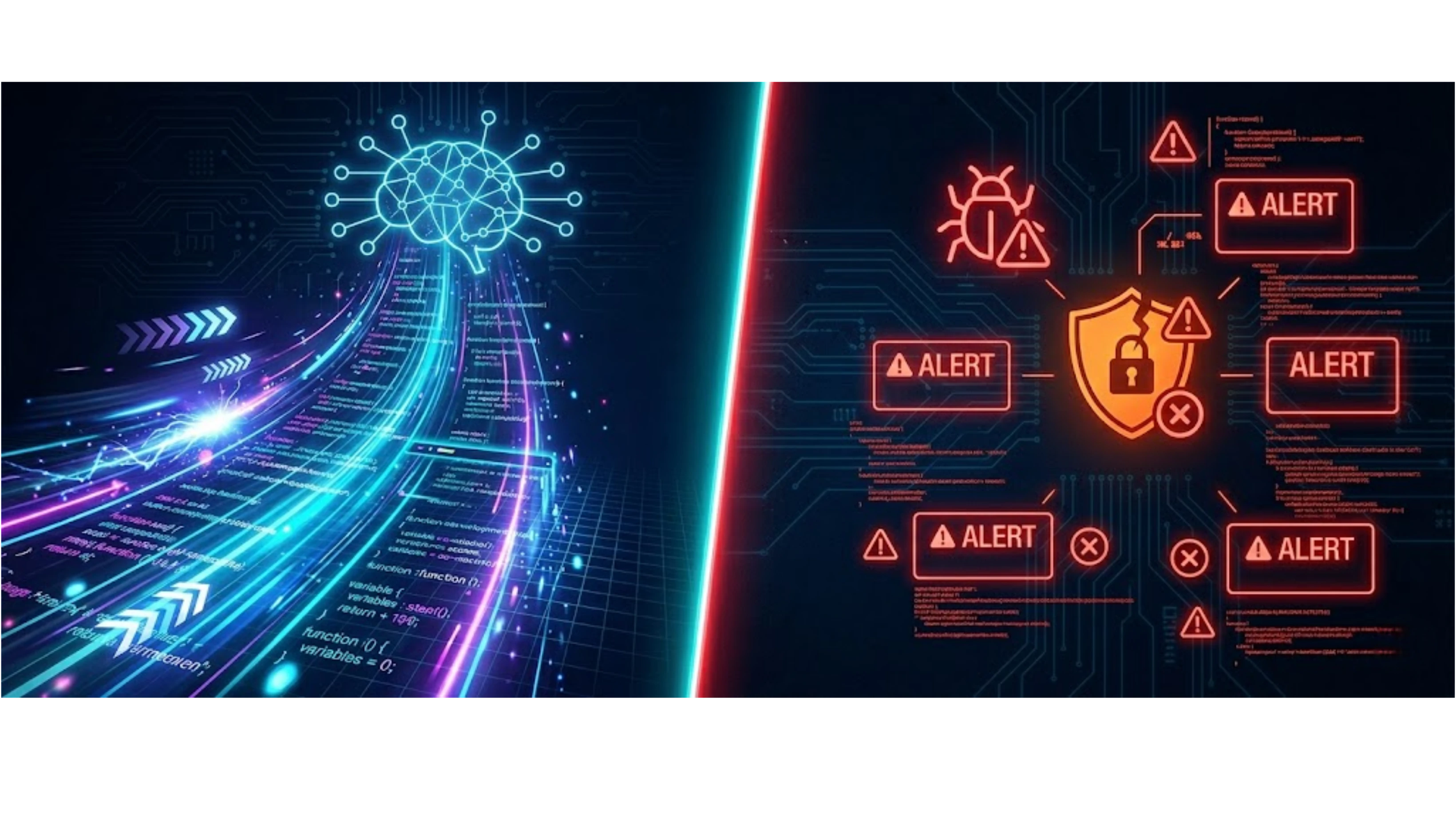
We're already seeing problems in the real world:
- A security check found that 170 out of 1,645 web apps created with vibe coding tools accidentally exposed user data because of a simple setup mistake.
- In a different incident, AI-assisted code accidentally deleted a main production database, even though it was told specifically not to touch it.
Industry veterans summarize the risk bluntly: vibe coding your way to a production codebase is clearly risky, since AI-generated code often hides bugs and security holes that developers don't fully understand. Just because the app "works" doesn't mean it's safe—you absolutely need human experts to review it.
Let's get into some more security blunders that AI generally introduces while vibe coding.
Real-World Patterns We're Already Seeing
AI has learned to code from public GitHub repositories, which are used not just by experienced, enterprise-level developers but also students, learners, and inexperienced coders. So despite vibe coding being a fairly new term and technology, some clear patterns have already started emerging across teams and products.
- 1. Leaving passwords and security keys visible
When a product is built, sensitive information like hardcoded passwords, API keys, and security tokens should be isolated from the main code to avoid misuse by unauthorized people.
Security scans frequently find hardcoded API keys, tokens, passwords, and JWT secrets, along with missing auth guards (checks to see if a user is logged in). Engineers from Checkmarx say AI tools often suggest temporary passwords (like an "admin:admin" default account) because they mimic bad practices from their training data.
There are also real-world examples of companies that suffered heavy financial losses because of these issues:
a. In one case, an Amazon Web Services (AWS) key was accidentally left in the code and pushed live. Automated attackers quickly found it and used it to run expensive crypto-mining operations, costing the company $50,000 in minutes.
b. Another startup left a backend-wide database unrestricted by failing to enable row-level security, exposing millions of records online.
- 2. Prompt injection and LLM tricks
AI is also bringing new kinds of security threats into products. AI models process instructions and user data in one stream, so cleverly crafted input can hijack their behavior. This "prompt injection" works like SQL injection for LLMs.
a. Recently, a hidden command like "Ignore all previous instructions..." placed inside a job applicant's resume fooled an AI screening tool into giving that candidate special, unauthorized access.
b. The Open Worldwide Application Security Project (OWASP) ranks prompt injection as the #1 AI model security issue. This means a system can be tricked by user content—even text, images, or hidden metadata—into revealing company secrets or executing harmful commands.
- 3. Old-school database mistakes (SQL injection and unsafe inputs)
Apart from new flaws and threats, AI is also bringing back old-school security issues that developers fixed years ago. If you ask an AI to find a user in a database, it might use an old-fashioned method that's vulnerable to a SQL injection attack.
Checkmarx reports that SQL injection is one of the most frequent flaws in AI-generated code. AI often skips important steps like input validation (checking if user input is safe) and sanitization, which are among the main security flaws found in AI code. Common, dangerous attacks like SQL injection and cross-site scripting (XSS) often sneak into AI drafts because the AI doesn't automatically follow secure coding rules.
These issues aren't new, but AI gives them a modern twist. The "conversation history," or hidden data the AI uses (called LLM context), can also accidentally reveal private information—testers have shown that models will repeat training data if asked the right way.
As Endor Labs summarizes: AI code takes both good practices and "legacy flaws" from the public code repositories it learned from. This results in brand-new, AI-specific security weak spots that only appear when closely checked.
Earlier, security issues used to come from mistakes developers made while coding. Now, they increasingly come from code that wasn't fully reviewed or understood. And that's a very different kind of risk.
What Is the Solution?
There are ways to avoid these and other issues posed by vibe coding.
- Human-in-the-loop: The idea of human-in-the-loop development is becoming critical. AI can speed up development, suggest solutions, and generate initial code, but it still needs humans to review architecture decisions, validate security, enforce best practices, and think through edge cases. Security isn't just about writing code—it's about understanding how systems behave when things go wrong.
- Build security into the automation (CI/CD/DevSecOps): Every time AI generates code, it should go through the same checks as human-written code. This—often called DevSecOps or CI/CD—means running automated scans to catch vulnerabilities (SAST) and checking whether any external libraries (SCA) are outdated or unsafe. It's also important to maintain a Software Bill of Materials (SBOM) to track everything the AI introduces. The rule is simple: never ship AI-generated code without proper automated and human checks.
- Test early and assume the worst (zero-trust): Modern security is about catching issues as early as possible. Test AI-generated code regularly—basic testing, full system testing, and even stress testing. Industry leaders recommend a "zero-trust" approach: assume all code and input from the AI is unsafe until you verify it. This includes granting AI-written code only the minimum access it needs (least privilege).
- Smart teams: The teams getting this right aren't avoiding AI—they're using it correctly. AI is used for speed, while humans bring judgment. They treat AI-generated code as a strong first draft, not the final product.
This is exactly where most businesses struggle. They either move too slowly without AI, or move too fast with AI but without control. What's needed is balance.
At Avisoft, the focus isn't just on building fast, but on building systems that are:
- Secure
- Scalable
- Production-ready
With AI as an accelerator, and experienced engineers in the loop to ensure clean architecture, strong security practices, and real-world reliability. Because at the end of the day, shipping fast is great—but shipping something that breaks, leaks, or fails under pressure is far more expensive.
Instead of selling the "magic of AI," the focus is on the practical side of software engineering—getting things to work properly in real-world conditions.
That's why Avisoft provides dedicated remote tech teams of vetted professionals with proven enterprise experience.
If you're building with AI and want to make sure your product is not just fast, but secure and reliable, it's time to bring in experienced engineering oversight.
Connect with Avisoft's team to audit, validate, and strengthen your AI-generated application before it goes live. Share your requirements, and turn your AI-built MVP into a secure, scalable product.
Where Vibe Coding Gets Risky: Security Starts Taking a Hit
Code quality issues are inconvenient, but security issues are expensive. When developers rely heavily on AI-generated code, they are also allowing AI to make security-related implementation decisions. While AI can generate working code, it does not reason about evolving attack patterns, business-specific security requirements, or long-term system safety.
The result is software that appears production-ready but often contains hidden vulnerabilities. AI focuses on producing syntactically correct code, not necessarily secure code. Human review remains essential before shipping applications to real users.
⚠️
The Biggest Security Myth
Just because an AI-generated application works does not mean it is secure. Functionality should never be mistaken for security.
Every AI-generated application should undergo architecture reviews, security audits, and human validation before production deployment.
🛡️
Production software requires engineering judgment.
Real-World Security Patterns Already Emerging
AI models learn from millions of public repositories. While those repositories contain excellent engineering practices, they also include outdated patterns, beginner mistakes, insecure examples, abandoned projects, and vulnerable implementations. As a result, AI can unintentionally reproduce security flaws developers solved years ago.
- Hardcoded Passwords and Secret KeysOne of the most common issues found in AI-generated code is exposing sensitive credentials directly inside the source code.Developers regularly discover API keys, passwords, JWT secrets, access tokens, and database credentials embedded within generated applications.Instead of securely loading secrets from protected environments, AI sometimes suggests placeholder credentials or insecure defaults that accidentally reach production.
- Missing Authentication and AuthorizationAI often focuses on making features work instead of ensuring only authorized users can access them.Generated applications may miss authentication guards, role-based access controls, or proper permission validation, exposing sensitive functionality to unauthorized users.
- Prompt Injection AttacksApplications powered by LLMs introduce an entirely new attack surface known as prompt injection.Unlike traditional applications, AI systems process instructions and user content together. Carefully crafted prompts can manipulate the model into revealing sensitive information or ignoring intended safeguards.
- SQL Injection and Unsafe Database QueriesDespite being one of the oldest web security vulnerabilities, SQL injection continues appearing in AI-generated applications.AI sometimes generates raw database queries without proper parameterization, input validation, or sanitization, making applications vulnerable to malicious user input.
- Cross-Site Scripting (XSS)Generated frontend applications occasionally render user input without escaping dangerous HTML or JavaScript.This enables attackers to inject malicious scripts capable of stealing cookies, authentication tokens, or user sessions.
Examples from the Real World
- An exposed cloud access key allowed attackers to launch unauthorized cryptocurrency mining workloads, resulting in significant financial losses.
- A startup accidentally exposed millions of database records because row-level security was never configured.
- Security researchers have demonstrated that prompt injection attacks can manipulate AI-powered systems into revealing confidential information.
- Production AI applications have accidentally modified or deleted important infrastructure because generated automation lacked sufficient safeguards.
These incidents highlight an important reality: AI does not intentionally create insecure software, but it also does not understand the consequences of insecure design choices. Without experienced engineers validating the output, vulnerabilities often remain hidden until attackers discover them.
Why AI Repeats the Same Security Mistakes
Large language models generate code by predicting patterns learned during training. Since public repositories contain both excellent and poor coding practices, AI can reproduce outdated approaches alongside modern ones. It cannot always distinguish between demonstration code, experimental implementations, and production-grade engineering.
Common security weaknesses found in AI-generated applications include:
- Hardcoded credentials and API keys.
- Missing authentication and authorization checks.
- Insufficient input validation.
- Unsafe SQL queries.
- Cross-site scripting (XSS).
- Insecure dependency selection.
- Weak error handling.
- Excessive permissions for backend services.
- Poor secret management.
- Incomplete logging and monitoring.
Earlier, security vulnerabilities usually resulted from developer mistakes. Today, organizations face an additional challenge—shipping AI-generated code that nobody has fully reviewed or completely understands. That fundamentally changes how software security should be approached.
🔐
Key Takeaway
AI accelerates development, but security cannot be automated away.
Every AI-generated application should be treated as untrusted until it has passed code reviews, security testing, and architectural validation.
🚀
Speed without validation creates unnecessary risk.
How to Build AI Applications Securely
The solution is not to stop using AI. AI coding assistants dramatically improve developer productivity and reduce the time required to build software. The real objective is combining AI-generated speed with experienced engineering judgment. Organizations that successfully adopt AI treat it as an accelerator—not a replacement for software engineers.
1. Keep Humans in the Loop
Human-in-the-loop development has become one of the most important engineering practices in the AI era. AI can generate code, recommend implementations, and automate repetitive work, but experienced engineers should validate architecture decisions, review business logic, enforce coding standards, and verify security before deployment.
Security is never just about writing code. It requires understanding how distributed systems behave under failure, identifying edge cases, and anticipating how attackers might exploit vulnerabilities—areas where human expertise remains irreplaceable.
2. Build Security into Your CI/CD Pipeline
Every AI-generated pull request should pass through the same engineering workflow as manually written code. Automated security validation should become part of your continuous integration and continuous delivery pipeline instead of an afterthought.
A secure AI development workflow should include:
- Static Application Security Testing (SAST).
- Software Composition Analysis (SCA).
- Dependency vulnerability scanning.
- Secret detection.
- Software Bill of Materials (SBOM).
- Automated code quality checks.
- Mandatory peer code reviews.
The rule is simple: never deploy AI-generated code directly to production without automated security scans and human approval.
3. Test Early and Assume Nothing is Safe
Modern engineering teams increasingly follow a Zero Trust mindset. Rather than assuming AI-generated code is correct, they assume every generated component may contain bugs or vulnerabilities until proven otherwise.
Recommended validation includes:
- Unit testing.
- Integration testing.
- End-to-end testing.
- Security testing.
- Load testing.
- Penetration testing.
- Fuzz testing for APIs.
This approach significantly reduces the likelihood of hidden vulnerabilities reaching production while improving long-term software quality.
4. Build Teams That Combine AI with Engineering Experience
The most successful software teams are not avoiding AI—they are learning how to use it responsibly. AI generates the first draft, while experienced engineers refine architecture, optimize performance, strengthen security, and ensure maintainability.
This balanced approach allows organizations to benefit from AI-driven productivity without sacrificing software quality or security.
AI vs Human Responsibilities
| AI Excels At | Engineers Own |
|---|---|
| Generating boilerplate code | System architecture |
| Rapid prototyping | Security reviews |
| Documentation | Business logic validation |
| Code suggestions | Performance optimization |
| Feature scaffolding | Production readiness |
| Developer productivity | Long-term maintainability |
The Bottom Line
Vibe coding has fundamentally changed how software is built. Founders can validate ideas faster, startups can launch MVPs sooner, and engineering teams can eliminate repetitive development work. However, speed alone should never be the measure of successful software delivery.
As products mature, security, maintainability, scalability, and architectural quality become far more important than initial development speed. Organizations that treat AI-generated code as production-ready without proper validation expose themselves to technical debt, security vulnerabilities, and expensive failures later.
🚀
The Future of Software Development
AI is transforming software engineering, but engineering expertise remains the competitive advantage.
The winning strategy is not AI versus developers—it is AI working alongside experienced engineers to build secure, scalable, production-ready software.
✅
Build faster. Validate thoroughly. Ship confidently.
Let's Build Secure AI-Powered Products Together
At Avisoft, we combine AI-assisted development with experienced engineering teams to deliver software that is not only built quickly but also secure, scalable, and production-ready. Every AI-generated component is reviewed, validated, and strengthened before deployment.
Our engineering teams help you:
- Review AI-generated codebases.
- Perform architecture and security audits.
- Modernize MVPs for production.
- Implement DevSecOps pipelines.
- Improve scalability and maintainability.
- Strengthen cloud and application security.
- Build enterprise-grade AI applications.
If you are building software with AI and want to ensure it meets enterprise standards for security, scalability, and reliability, connect with Avisoft's engineering team. We'll help transform your AI-generated MVP into a production-ready product that your business can confidently scale.
✍️
Let's Talk
Are you looking to leverage AI development powers to develop quick custom solutions for your business?
If you are looking for a tech partner who can combine domain expertise with AI co-development capabilities, write to us at tech@avisoft.io.